

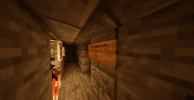
The official map of Karakura doesn’t include a decrpet place as such. The Labyrinth was first built as an early part of the sewer system. Construction blueprints have been found, estimated to date back to the late 1860s, during the Meiji Restoration. During a period of modernization and construction, the original foundations of what lies underneath were being worked on. A change was being instated within the town of Karakura, as a new wave of ideas arrived. There was a project that circulated, one that suggested how to utilize the town's unused space. Katsushika Tōwa, the man who conceived the idea of a passageway formed in stone to guide individuals and the excess water that was provided.
Countless hours spent brainstorming, only for one to stick repeatedly. The original process he wanted was marked down in a small journal he kept, incomprehensible to most - written in the dim candlelight, with the nearest ink he could find. The stark ink was smudged yet legible to a certain degree. He proposed a plan to the board, one that suggested what the space should become. Katsushika recorded each idea, each thought process that came to him about the area. And then he finalized his finished products. The documents described what would be done: an extensive network, an intricate system of drainage that spans between corridors built beneath the older tunnels.
The starting point, the two points where they would work backward. An original point where water dripped out of the stone in different areas. Construction started as they built inward. They began with duplicate channels, where water flowed in separate directions, eventually leading to separate parts of the sewers. Labeled ‘Dual Channels,’ it was something that the workers referenced as their starting point, the name sticking as work continued. Every day, a different project was worked on by various individuals. With specific tools dedicated to chipping stone and paving concrete, they made their way backward through the tunnels, paving the way for the blueprint. Each path, each weight that the cement carried between the stone bricks left a drag mark. Weeks passed, the ground unearthing, before they reached a pit of magma. Instead of sealing it back to its original state, they used it to their advantage. Documented as their ‘incinerator,’ they used it for such. The rubble and waste brought with them were well-disposed of within the heat. With a plan to continue, they dug around the pit, digging inward toward their original goal. More time had passed, and each passageway was becoming finalized. With their maps, they navigated to their unfinished projects, which consisted of a closing portion featuring four different doors. They were used as a distraction tactic for anyone who hadn’t worked on the project. It wasn’t meant to be understood by the public, only navigated by those who knew how to. This portion, their finale, was labeled ‘Four Entries.’ Specialists brought someone with them each time an entry was made.
In the midst of building, when the concrete was laid on the walls and dried, the stranger the layout became. Report after report came in, contractors mentioning junctions that didn’t align closely with what the prototype had planned. Some swore that passageways that had been bricked off weeks prior had opened up overnight. Others simply quit, refusing to go back to the facade-laced stone bricks that covered the floor plan. The workers on the project developed extreme paranoia, Katsushika amongst them. They began destroying the stone that had been built, trying to escape the walls ‘closing in on them.’ The construction team destroyed an uneven path that bled into the sewer lining of the Kagoshima District Sewers. After all that had happened, the project was abandoned and sealed off, left to rot away beneath the newer lines.
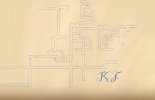
[!] A yellow-stained paper, old in its manner. An unknown time period from where this page was. The stationary item appears as if a single touch could cause it to disintegrate. Found in the depths of the stone, the only readable trait was two letters: K. T. In the smudged, blue ink, pathing could be made out. Wherever this guide leads, it reads as if someone was meant to get lost. [!]