PUBLIC ENEMY NUMBER ONE
Level 22

The La Cosa Nostra: How to Play a Mobster, Structure, Law Enforcement, Lifestyle & More
INDEX: INTRODUCTION I. THE LA COSA NOSTRA II. STRUCTURE III. OPERATION & BUSINESS IV. TERMS, LANGUAGES & JARGONS V. CREATING A CHARACTER VI. THE REALITY OF THE LCN VII. GOVERNMENT, LAW ENFORCEMENT & RESOCIALIZATION VIII. INTERPERSONAL RELATIONSHIPS: FRIENDS IN THE MOB IX. MAFIA REALITY VS. SRP LIMITS X. FITTING AN ITALIAN MOB INTO JAPANESE KARAKURA |
INTRODUCTION
This guide serves the purpose of introducing, teaching and guiding players who aim (or have aimed) to confidently portray an individual (or group of individuals) involved within the modern-day Italian mob, specifically the La Cosa Nostra. This guide extends past what is known from the movies or TV shows, and instead aims at the core of the organization.
Before we begin, it's important to note that while this guide explores the real LCN, it may also attempt to fit the Italian mob's reality into SRP's universe; obviously, the LCN has no hold over Japan, and has no families or cells there. This won't stop players from making LCN-inspired gangs, though, since SRP is what we make of it, after all.
We will go through common LCN activities and methods of operations, methods and businesses, whilst adding a note or two about how to fit these into SRP. Before we explore the practices of the LCN, it's important that we first make some key aspects clear.
And finally, this thread isn't meant to impose standards or dictate how things should be done! It simply aims to teach anyone who wants to learn or is interested in the topic, since LCN-derived gangs have been such a relevant piece of SRP gang-RP culture. If this is a topic that interests you, feel free to read.
I. THE LA COSA NOSTRA
The La Cosa Nostra is the oldest criminal organization in existence, and is still active to this day. Because this guide aims at explaining the modern-day mafia, it's important to point out that the LCN has lost a lot of its influence over the last decades, especially during the end of the 20th century, where law enforcement worldwide tightened its grip over the organization - in the US, the RICO Act severed the strength of all Italian-American families, decreasing the organization's financial power, whilst diminishing organized crime violence in the country, but especially in the American east coast.
Today, the group is much quieter, as well as smaller, operating mostly through white-collar fraud and the harassment of local businesses, rather than violent, family-family street wars. But most of all, the LCN has become a selective hub for business-owning and (mostly) legal profiting.
II. STRUCTURE
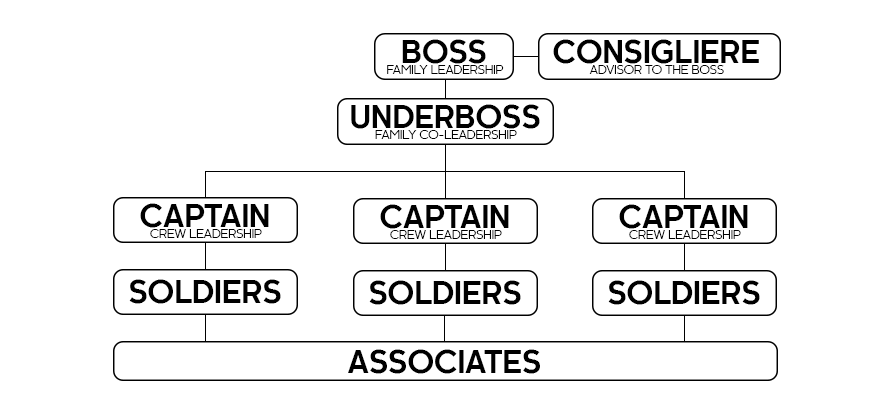
The La Cosa Nostra is a decentralized organization, akin to the Yakuza, operating as a sort of confederacy of loose families and cells, each with its own operations and means of profit. Family A rules over a certain region of a certain territory, while family B controls a neighboring region. Most of the time, a city, depending on its size, may be home to three or four families.
Each family is ruled by a boss, or a capo, along with his underboss - this is the family's leadership (mostly called "administration"), who manages the group's businesses and takes most of the profit that's passed to them by the lower-ranking mobsters. These are heavily respected members not only of the family, but of the region, the country and the organization as a whole. Because the LCN isn't uniform (at all), bosses come in many different shapes and forms: some are authoritarian, powerful men, whilst some maintain a close proximity with the family as a whole. These are profiles that also influence the leadership's finances, since some bosses will want to tighten the family's pockets so they can keep the cash to themselves. The family's response to these may vary, though, but mobsters aren't fully loyal, especially in today's age.
Families have a set of crews - a selected number of soldiers, who work under a captain, who manages his crew's operations. Each crew controls a territory, manages one or more businesses, maintains their schemes and generate profit, which together, along with the rest of the other crews, make up the family's turf, or zone of influence: businesses, clubs or safehouses, whatever the family or the crew claims to be theirs is part of their turf; the boss entrusts his captains to make money and maintain their turf, and the captains trust their soldiers to fulfill their attributions within the crew they're part of.
Captains are closely involved in their crew's operations, delivering tasks to their soldiers so they can be accomplished, whilst micromanaging the businesses they own or control: a captain may run a loan shark operation, which is rolled out by a few soldiers, who now have to collect this debt from a guy who previously needed cash to properly run his cafe. Another captain may own this small shop, usually used as a meeting point among his crew, but it's actually nothing more than a place for money laundering. In short, if the boss is the general manager, captains are the regionals.
Each crew, as mentioned previously, has its captain and his soldiers. But it also has its associates: contributors to the family or its crew, recently-integrated into the cell's schemes, upon invitation from a soldier (or very rarely, the captain himself), who execute certain tasks until (or if) they're made.
Associates haven't been inducted yet, so they're not exactly in the family, but they're also not completely disconnected from it; this is why they're often referred to as "connected men". You may become an associate when a soldier notices your work and "connects" you to the crew's operations; this means you're now under a soldier's close watch - they will provide you with means of running your own schemes and operations, or assist you with concluding a task or fulfilling an order - they are, after all, responsible for you from the second they've invited you in. Soldiers may also have their own small crew of associates.
Being an associate also means sharing part (or most) of your illegal profit to your soldier, who will then share part of it to his captain, who will share part of it to the family's leadership. Because you're at the very bottom of the pyramid, you can expect to be ripped off often until you're a wiseguy. At least, you're the telephone between the family and the streets - it is you who will carry out most of the dirty and illegal work.
Finally but not least, there is also the consigliere: a family veteran acting as a neutral advisor who carries profound institutional knowledge, specifically and individually hand-picked by the boss to offer important advices about past, current and future matters, although there have been instances where the consigliere was voted in, instead of being chosen by the administration. The consigliere is picked as soon as a new boss takes the throne, or remains in the position despite leadership changes due to historial knowledge, experience or reputation. Primarily, the consigliere is supposed aid the family's administration in many important matters, serving as a consultant and, often times, mediator.
III. OPERATION & BUSINESSES
Whether Karakura's LCN operates through violent means or remains hidden in the crime underworld is up to whoever is running it, but it's important to meet, know and understand how the LCN makes money and conducts its affairs.
Many families operate differently from one another. This comes down to the family's administration, culture, history and other factors. The Italian-American mafia was increasingly violent in the late 20th century, but became heavily moderated in the late 90s and from the early 2000s onward. The region also defines the family's strenght and relevance: the Los Angeles mafia, for example, which composed of only one big family, was far more tame than the NY families, which engaged in violent crime, especially in the 70s and 80s.
The LA families were constantly mocked by their fellow mafiosi for being figuratively weak, although expecting one west coast family to hold the same relevance as multiple different east coast families wasn't a fair comparison at the time. The LAPD also served an important role in keeping the LA mob in check through corrupt and abusive policing, while the NY police, although bigger in numbers and resources, was heavily compromised, since the New York families were deeply politically involved in the state and city government.
The difference in numbers of made men between the LA and NY families also put the west coast mob under great disadvantageous terms - in short, the Italian-American mob's throne was always held in eastern US, not in the west.
This section will touch the means of profit held by the mob, although without mentioning all of them, since some go directly against SRP rules and wouldn't be applicable in-game anyway.
Extortion & protection rackets: This is the most common form of profiting in the mob: the act of forcing business owners to pay a "tax", or in other words, protection money, in order to be protected from the mob itself. If the offer was made and the business owner either refused to pay or to continue paying, their business would be depredated and vandalized by the same people who offered said protection. In order to roleplay this out, OOC consent from the potential victim's player is necessary (read chapter IX).
Loan sharking: Lending money to desperate individuals, who are likely going through financial crisis, preying on their necessity to profit off of it. Mob loans come with astronomical interest rates, and can (it often time does) turn into a scheme of extortion, by keeping the payment going even when the loan is fully acquitted. Oftenly, mobsters threaten the debtor with violence.
Weapons trafficking: Establishing a weapons trafficking line in Karakura is both risky and perhaps greatly lucrative, although by doing so, you'd be acting under the BM and KPD's very noses. Realistically, the mob is a relevant player in the smuggling and trafficking of weapons, although not all crews or families engage in this type of operation, due to the high risk that comes along with it.
Labor racketeering: Infiltrating and taking over workers unions with the intention of embezzling the union's pension funds was, although outdated and out of fashion, one of the main methods of profit used by the mafia.
Hits & hired murder: Some families had hitmen for hire, although most did inside jobs for the mafia itself, some attended to and did services for the general public.
Bars, restaurants and other establishments: This was one of the most common methods of operation, almost mandatory for any family or crew: owning a business and using it for money laundering, hiding the dirty money from the tax men. In fact, this was so common that most indictments and arrests were based solely on fraud charges.
Hijacking of the construction and/or waste management industry: By owning or infiltrating construction or sanitation companies, the mob acquired the power to manipulate and rig public contracts, establishing contact lines with corrupt politicians, inflate prices and virtually control the regional market. A classic operation seen in almost every medium that features the mafia.
Cybercrime & identity fraud: Selling fake throwaway credit, debit cards or SIM chips, conducting phishing scams, hijacking bank accounts, these are operations born in the early 90s, with the rise of the digital and internet age. The mob quickly adapted to earn digital cash.
IV. TERMS, LANGUAGE & JARGONS
It's only natural that a secretive organization such as the LCN adopts many jargons and ways of speech; this is a culture developed in the 20th century, when the federal government was all over the organization's business. Not only this, the expressive manner behind the Italian culture also contributed to the introduction of unique ways and methods of communication.
Being a "made man", a "wiseguy" or a "good fella": These are commonly-used terms to refer to soldiers, captains or any other inducted member of the family: sworn criminals who diligently serve the family (except when they don't). Being made means you're now an official part of the La Cosa Nostra, or this thing of ours - you now are granted a few privileges and rights, as well as a raise in pay, but also in responsibilities and commitment. Whether you became a made man after a traditional ceremony or you just had a talk with one of the powerful people varies from family to family, but what truly matters is that you're now a wiseguy, and they will treat you with respect.
"The books are closed", or "the books are open": Even an organized crime cell has contingent control. There shouldn't be more soldiers than what the family is capable of holding (the books are closed), and there shouldn't be too little to the point where the family and its crews can't carry out their duties (the books are open). When the books are open, it means the family is looking to turn or promote some associates into made men. When the books are closed, the family is not looking for new soldiers.
A sitdown: Every group of friends has conflicts, and the LCN took a step forward to avoid these from escalating. A "sitdown" is when two made men sit and "talk their differences" out, accompanied with a mediator, whose rank depends on the disputees'. If two soldiers have beef, a captain may hold a sitdown with them. If two captains have beef, the boss or underboss intervenes. A sitdown aims to settle the dispute, that may derive from a number of issues. Perhaps a captain is operating a weapons trafficking line within another captain's turf, or a captain's soldier got into a fight at another captain's establishment. With the context in mind, the mediator will look for a solution that pleases both parties, although this is not always the case. Sometimes, though, one (or both) of the parties end up pursuing a solution without the need for an intervention, maybe so leadership doesn't find out or out of genuine good faith. The LCN is not uniform.
Kickups: Like mentioned before, each member has to pay their share of the profit. Most people would believe if they heard that the concept of pyramid schemes originated from the LCN, because it's fully believable. Everyone must split their earnings to whoever they respond to: an associate to a soldier, a soldier to their captain, their captain to administration. If you want to have a fulfilling future in the mob, make sure your envelope is fat.
The Omertà: The Omertà is a code of conduct that exists within the Italian mafia and must be followed by everyone. It contains rules and dictates standards that won't be mentioned in this guide (because it's too long), but it's the most important piece of documentation, history and tradition within the mob. It mentions the code of trust, rules of conduct and upholds confidentiality.
Making one's bones: To make your bones is to prove your loyalty and commitment to the mob, usually in the form of violent crimes - on SRP, this could easily be roleplayed as the delivery of majors or KPS, which would fit what the term is historically known for.
The Commission: "The Commission" often refers to entities with immense power within the Italian mob underworld: the Italian-American mafia commission, the central Sicilian mafia commission, referred to as "La Commissione", as well as others. Whilst La Commissione doesn't serve the role of a "central command for all mobsters worldwide", it is still an organization held with much respect amongst fellow mafiosi. These aren't the only Italian mob commissions - each region has its own: the famous and historical Five Families of New York were part of their own commission, and often held talks to avoid inner violence amongst mafiosi, whilst maintaing a tight grip on American organized crime.
Vouches: One of the most sacred and risky acts a mobster can do is vouch for someone: a wiseguy putting a word in favor of another person means risking their reputation, and sometimes, their life. Vouching serves many purposes: recommending an associate to a higher-up, getting someone out of trouble or swearing in the name of a person. As a made man, your word is taken with absolute seriousness and trust. However, by vouching for someone, your soul is automatically bound to the issue at hand, and you will be responsible for whatever outcome originates from your imposed trust. These are common practices made to ensure that made men only defend what they truly believe is right.
Shelving: Serving as a work-around to murdering a family member, shelving someone is to completely isolate them from the family: no one will talk to you or do business with you, and you will be no longer involved in the family's affairs. You may be taken out of the shelf, or you may just be completely excluded from ever acting as a made man again.
V. CREATING A CHARACTER
Whether you want to join an LCN-inspired criminal group, wish to create your own or have been invited to roleplay in one as an already-made man, it is important that whatever character you come up with is aligned with the realities of the Italian mob - if this is what you're aiming for anyway.
Name: It is extremely rare, if not utterly impossible, that non-Italian descendants partake in the LCN's operations. Depending on which gang you're joining or creating, your character's first name may be American (if this is an LCN-derived gang with roots in the US), or a Japanese first name (if this is an LCN-derived gang with roots in Japan or Karakura). As to your character's last name, obviously, it must be Italian. There are many name generators online - simply pick a first name of your choice, and put it before an Italian one. Let's try not to choose names of famous personalities or TV characters!
Background & Story: It's time to add flavor to your character, unless you aim to roleplay and nothing else (even if I'd argue that your character's backstory is as important as the roleplay itself). Ask yourself important questions that will help form your character's story and future development: where did he come from? Was he born in Japan? Which generation of descendants is he? What is his view on crime? Is he doing it out of necessity? How violent is he willing to be? Why did he join the family?
The last question is usually the trickiest. What was his true reason to be part of this thing of ours? Of course, there are psychopaths and sociopaths around, but the chances of your character happening to join the family out of necessity rather than being a crazy lunatic is much more plausible. Today's made men once lived desperate lives due to financial problems, fear or whatever else. Maybe he's just genuinely interested in the mafia, but would he have weighed the pros and cons of picking this kind of lifestyle?
Age: Your character is probably a new face in the mob; most of them are. People are usually introduced to this way of life very early, through influence from family, friends or due to societal issues. Most join at the ages of 18 to 25, become made in their 30s, get a promotion to captain in their 40-50s, and become boss or underboss in their 50s to 80s, until they die. Young bosses have been a thing in the past, but only under special circumstances. Either way, feel free to roleplay whatever age you want, but realism is always nice. Nobody enjoys roleplaying an old dude either way.
Looks, Personality & Commons: What most people think a mobster looks like was shaped after decades of mafia media: men in fancy suits and hats with expensive cars. Although the last part may be true for high-ranking gangsters (and even that is risky, no one wants to be caught by the tax men), the modern-day mobster dresses no differently from a normal Joe. Looking normal is, in fact, very advantageous, since it helps to move the spotlight of law enforcement away, enough that it became part of everyday mob life. The mystical, vintage culture of the mob has been washed away throughout the years, and mafiosi aren't different from a day-to-day guy.
Personality-wise, it's important to weigh your character's traits, qualities and flaws. Although most people aim for the psychopathic murder machine, this isn't (and never truly was) real. Although there may be sociopaths in the mafia (like there is everywhere), these are character traits that must be picked with caution so you don't end up roleplaying the usual, cliché and dull self-insert Karakura criminal. Keep in mind that even the most street-hardened outlaws are normal individuals with feelings, thoughts and emotions.
The creativity SRP provides to its community is insanely underrated. There are so many ways to expand your character's development and personality, and the best part is that these are aspects of the roleplaying universe that can be coordinated by you alone! Maybe your character is having a bad day, overwhelmed by the outlaw reality, or even mundane events - maybe your character owes big money to the Karakura General Hospital, which although never happened in a mechanical, Minecraft script/gameplay-wise way, if this will bring flavor to your character in any way, shape or form, then go ahead and roleplay it!
VI. THE REALITY OF THE LCN
The LCN is surrounded by different mechanics that are ever-present in the life of a mobster: politics, internal relations, management and what else may come in the way of a made man. Despite its complexity, this is a deeply flawed organization, with rooted injustice that takes place across all families and crime cells. Whoever is on the other hand of the spear isn't well-defined either: it may be a rule-abiding soldier whilst the rat is earning more and more. Just like crime, the organization's treacherous nature is, in one way or another, promoted by all administrations worldwide.
Does this mean your character should be worried that his boss will stab his back sooner or later? Not exactly. Many families are united and, although people are after their own interests at the end of the day, the sense of unity and camaraderie can often times blind people. The mob is surrounded by internal and external politics, and being good at maintaining a reputation is what will grant you a fulfilling life in the mafia.
If your earnings are good, your boss will be more likely to rule in your favor during a sitdown - the LCN is and promotes corruption, in a way so natural that it doesn't even have to be intentional. Such is crime and organized crime cells, LCN or not. Being a mobster means you must direct your attention to where everyone else is looking, and if everyone is looking at you, you should rewind your last couple of weeks and figure out what you possibly could've done wrong.
Nowadays, the LCN is severely crippled worldwide, having lost most of its relevance along the years due to heavy federal and international intervention. The mafia isn't, and most likely will never be, what it once was. Modern-day mafiosi deeply fear the authorities, and will rat their fellows out and join the Witness Protection Program if need be, although a handful are still irrationally loyal to the organization.
The Italian roots, once cherished by mafiosi around the world, have also died down amongst international LCN families. Nowadays, a mobster, even if they are made, can't recall more than 5 Italian words, dishes or practices. The Cosa Nostra has stepped away from maintaining its traditions and has embraced a newer generation of criminals, who in turn never valued that the organization once stood for.
It's important to note that more than half of the information that you can come across online regarding the mob is severely outdated. The LCN is an ever-changing organization, and the ways of 20 years ago aren't applicable today. Read more below.
VII. GOVERNMENT, LAW ENFORCEMENT & RESOCIALIZATION
The resocialization system works. Not in the sense that most people think, though. If we adapt the government's watchful eye over the mob to current Japanese law enforcement reality, it's fair to say that the mafiosi wouldn't last long. But this is SRP, and we can assume KPD hasn't expanded its grasp over the Italian-Karakurean organized crime yet, or whatever people choose to roleplay.
For someone whose life was entirely dedicated towards crime, being locked up has certainly crossed your character's head at least a hundred, two hundred or a thousand times. It's only natural to be paranoid when a considerably relevant portion of your activities revolve around crime. Using codewords to refer to criminal inner operations, using from pay phones and having a special compartment at home to speak about illegal stuff, these were common practices adopted by mobsters across the world.
While it's (almost) impossible to conduct prison RP on SRP, it is possible to roleplay your character after serving his sentence. Why was he there? Was he snitched on, or simply wasn't slick enough? How was his time in prison? How will he portray himself after serving? Will he change his ways, methods or schemes? These are questions to be had in order to deliver quality RP.
Law enforcement has always been in a forever war with the Italian mob, international and local forces alike. The LCN has been a matter of public security concern since ancient times, and still holds up to it to this day. While law enforcement fights the LCN with indictments, jail cells, courts and guns, the LCN fights law enforcement with discretion and attorneys. This is a reality that can be well-extended over SRP, with the involvement of the city government's lawyers who can play an important piece in the greater theater of SRP crime.
Although different families set under different cultures and behind different borders, both the Italian-American and the Sicilian mobs fell the same way: due to the blow dealt by the government. The Italian-American mafia suffered a catastrophic decline due to the RICO Act, which destroyed its top leadership and caused the arrests of multiple made men, beheading the organization's leadership in America. The RICO Act targeted not only the mafioso, but also the industry, the assets and everything the Italian-American mafia ever stood for.
The Sicilian Cosa Nostra fell after waging an intense and violent paramilitary war against the Italian government, which led to its eventual dethroning after the use of military, legislative and judicial force by the federal government. The Italians, after years of living under the Sicilian mob's systematic control, fought back with the use of cultural shifts, legislative changes and incisive surveillance operations. In the 90s, the Italian government sent troops to the Sicilian island, seiged it and increased sentences against relevant, top-of-the-pyramid mobsters. These are stories and records that every mafiosi, no matter which country they operate from, knows.
In the era of information and surveillance, the mafiosi are smart enough to know they're being watched 24/7. This promotes aforementioned paranoia, and encourages them to be stealthier in how they go about their business - what once used to be a murder machine has turned into a much tamed borderline-illegal international operation.
This takes us to an issue that once was the mafia's biggest enemy: snitching; this was a major infraction of not only the Omertà, but also of the common values upheld by fellow mafiosi. The act of ratting out your fellow mobsters to the cops was deplorable, but also very appealing in dire times. All it took, most of the time, was for a couple of detectives to put them in a chair, promise witness protection and they'd get whatever they wanted. This is still a real issue to this day: being a rat.
VIII. INTERPERSONAL RELATIONSHIPS: FRIENDS IN THE MOB
The general consensus is that there is unity in the mob, and therefore, there is friendship. Unfortunately, this ****ogy is wrong and misses important clues about mobster-mobster relations. It'd be fair to assume that a wiseguy is friends to his fellow wiseguys - they do, after all, share the same environments, frequent each other's birthdays, help solve (biological) family issues and whatnot, but make no mistake!
These are men who aim for their own interests. If there is unity, it's purely because unity brings stability, and stability brings profit. Mafiosi hold no true interpersonal relationships with anyone in the mob; having a friend means fully and blindly trusting them, but blind trust doesn't fit within the setting of the mob - if you're not cautious, the guy who showed up to your BBQ party could be the one who snitches on you.
To be in the mob is to have developed an intense sense of arrogance, to the point where you had to forsake your life in order to fully dedicate yourself to get rich over others' expenses. This fact for itself implies a rotten inside and irreversible lack of self-awareness. This doesn't mean, though, that your character is an inherently bad individual; only that he's surrounded by them.
IX. MAFIA REALITY VS. SRP LIMITS
It's fair to say that the Italian mob's realism is incompatible with the SRP environment - a topic that's often seen as "mature" has no place in a game made for and played by children and teenagers. This is absolutely true, and also the reason why this thread doesn't go into details on the intricacies of the lifestyle. But just like this guide limits itself to only mentioning moderated aspects of the mafia, it is possible to realistically roleplay a mafiosi without touching the unethical and immoral aspects of it - former real-life-inspired gangs had success in doing so: Santarossa and Akihito, although very different from one another, were both big and relevant SRP gangs that portrayed crime groups that promote violence in real life.
This is a tale as old as time: which line defines what's appropriate, acceptable and realistically ethical to be portrayed on SRP? How can players who are deeply interested in a certain niche, be it the LCN, the Yakuza, biker or racing gangs, enough that they want to roleplay it on SRP, properly act these niches out in a proper setting? Each of these groups promote and conduct crime, after all!
Some would claim the line lies on what the server defines as roleplay rules, while others claim there are non-official ethical and moral values that must be followed on every roleplaying setting. I believe it's both: server rules must be followed at all times, whilst the community must make a conscious effort not to promote scenes that may make other players uncomfortable, or roleplay that disturbs the well-being of an individual (or a group of them). This is mutual courtesy, and players that belong to a gang should not force others to partake in their schemes, scenes or actions.
This is being mentioned because gang RP, especially mafia RP, in the sense that was written in this guide, is entirely cooperative and community-driven, from the inside and the outside: members must work with each other in order to promote interesting roleplay, while the group must pursue outsiders to place themselves in the position of a victim. This model of mafia doesn't rely on the basic concepts of gang RP, which involves combat and permissions - it relies heavily on OOC outside cooperation, mutual fairplay and good sportsmanship. Leaders must be communicative individuals who are willing to gather people who will give the concept of a mafia a chance.
SRP conflict is heavily dictated by what's said on the rules, but the possibilities of agreed roleplay, as long as both parties are interested in and willing to engage in it, are close to infinite: extorting shopkeepers, collecting debt, and many other RP opportunities, as long as the delivering party is reasonable, can be enriching and very interesting. "Does this mean that most of the roleplay I carry out will be scripted?" Due to the current RP culture that exists on SRP, sort of. Does it mean it's a bad thing? Not exactly. If anything, getting an outsider to agree on being on the other end of crime RP can result in scenes that are more organic than if it was a spontaneous encounter.
X. FITTING AN ITALIAN MOB INTO JAPANESE KARAKURA
No Italian mafia has ever placed foot in Japan, or rather, not in an official manner. Although the point of this thread is to display a realistic way to portray the mafia, we can't keep it 100% realistic, if not for the reasons mentioned above, then due to this one specific impediment. But we don't have to make it 100% loyal to what it was/is in real life:
Playing in the mafia is, on any RP setting, throwing out what doesn't fit and compromising for what would make a great roleplaying asset. If there is no mafia in Japan, at least there is in Karakura, an out-of-the-ordinary city off the Japanese coast. Making an LCN-inspired gang is, if we care about realism, coming up with reasons (or most of the time, making them up) of why, how and when the Italian mafia ended up there. It only has to sound and look real enough so players can work around it.