
By Bartholomew Grant
Various forms of property exist in Karakura from apartments, penthouses, houses to Estates and private boats. The ladder two less accessible then the first trio, regardless if you live in an affordable apartment at Complex G or a Large house alongside the shōtengai all citizens expect a place to live and prosper, a home. And with this comes a reality of paying rent monthly. Every citizen if they own a property in some form will be faced with this truth, except a privileged few who own their property outright such as the Estate holders or the Bobcat and Spartan Teamhouses.
To put it short, there's a lot of properties in Karakura. 1,005 to be exact, at least according to this reporter's findings. And each property, given its available to be rented, is public record as anyone can visit outside a property and see whether it's currently being rented or not. Through this, we can reach certain conclusions such as the occupancy rates of each complex or property type. Painting us a picture with various implications about the city, such as what complexes are in high demand and which are very (sometimes extremely low) in value. As well, through an understanding of basic economics and market forces, why some complexes are more popular than others.
Methodology
Sadly, the best method this reporter found to ascertain the occupancy rates was to use two data points across all complexes, both of which involved somewhat manual collection. Firstly, the number of apartments or properties available for a given complex, this data was collected through calculation of apartment numbers based on the amount of floors and number of apartments on each floor, taking into account varying complex designs when required. This paired with counting the amount of unowned properties signs at each complex, a much more tedious and manual task. With this, we’re able to calculate the occupancy rate by subtracting the amount of unowned signs from the number of units, then dividing that by the number of units. For example, Complex T has 28 units and 16 unoccupied units, given our formula [(28-16)/28] we get an occupancy rate of 42.86%.Type | Units | Price | Median Rent | Type | Unoccupied Units | Occupancy Rate | Rent Paid |
|---|---|---|---|---|---|---|---|
| Houses (Non Estates) | 93 | ¥250,000 | ¥250,000 | House | 0 | 100.00% | ¥23,250,000 |
| Beach Houses | 9 | N/A | N/A | Temporary | N/A | N/A | N/A |
| Complex B1 | 15 | ¥50,000 | ¥50,000 | Standard | 0 | 100.00% | ¥750,000 |
| Complex B2 | 15 | ¥50,000 | ¥50,000 | Standard | 0 | 100.00% | ¥750,000 |
| Complex C | 25 | ¥50,000 | ¥50,000 | Standard | 0 | 100.00% | ¥1,250,000 |
| Complex A | 25 | ¥50,000 | ¥50,000 | Standard | 0 | 100.00% | ¥1,250,000 |
| Complex S | 18 | ¥250,000 | ¥250,000 | Penthouse | 0 | 100.00% | ¥4,500,000 |
| Complex T | 28 | ¥50,000 | ¥50,000 | Standard | 16 | 42.86% | ¥600,000 |
| Complex R | 28 | ¥50,000 | ¥50,000 | Standard | 17 | 39.29% | ¥550,000 |
| Complex Q | 16 | ¥50,000-¥100,000 | 75000 | Penthouse | 0 | 100.00% | ¥1,200,000 |
| Complex P | 48 | ¥50,000 | ¥50,000 | Standard | 10 | 79.17% | ¥1,900,000 |
| Complex M | 36 | ¥50,000 | ¥50,000 | Standard | 4 | 88.89% | ¥1,600,000 |
| Complex N | 23 | ¥50,000 | ¥50,000 | Standard | 0 | 100.00% | ¥1,150,000 |
| Complex K | 56 | ¥100,000-¥150,000 | 125000 | Penthouse | 19 | 66.07% | ¥4,625,000 |
| Complex J | 36 | ¥50,000 | ¥50,000 | Standard | 13 | 63.89% | ¥1,150,000 |
| Midori Penthouses | 24 | ¥100,000-¥150,000 | 125000 | Penthouse | 24 | 0.00% | ¥0 |
| Complex F | 100 | ¥50,000 | ¥50,000 | Standard | 2 | 98.00% | ¥4,900,000 |
| Complex V | 43 | ¥200,000 | ¥200,000 | Penthouse | 0 | 100.00% | ¥8,600,000 |
| Complex L | 106 | ¥50,000 | ¥50,000 | Standard | 59 | 44.34% | ¥2,350,000 |
| School Dorm Rooms | 70 | ¥15,000 | ¥15,000 | Dorm | N/A | N/A | N/A |
| Complex E | 36 | ¥50,000 | ¥50,000 | Deluxe | 1 | 97.22% | ¥1,750,000 |
| Complex D | 36 | ¥50,000 | ¥50,000 | Deluxe | 0 | 100.00% | ¥1,800,000 |
| Complex G | 90 | ¥15,000-¥50,000 | 35000 | Affordable | 35 | 61.11% | ¥1,925,000 |
| Estates | 5 | N/A | N/A | Owned | N/A | N/A | N/A |
| Boats | 6 | N/A | N/A | Owned | N/A | N/A | N/A |
| Complex O | 14 | ¥50,000 | ¥50,000 | Standard | 14 | 0.00% | ¥0 |
| Complex U | 4 | ¥50,000 | ¥50,000 | Penthouses | 0 | 100.00% | ¥200,000 |
| Total Units: | 1,005 | Average Rent: | ¥78,125 | Total Rent: | ¥66,050,000 |
However, you didn’t come to spend your whole time reading about how to form calculations and collect retail data. So, let us take a step forward and put this data to use.
Total Rent Paid
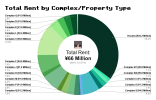
Once more using this data we can come to some interesting discoveries. One such finding being a rough estimate of the monthly rent paid by Karakurans citizens. We do this by multiplying the occupied units at every complex by the median rent from said complex (Some complexes rent ranges, e.g: 50k-100k). This gives us various findings we are able to discuss further.Firstly, we’re able to look at the total revenue for each complex or property. Emphasis on property as the largest revenue bringer is not complexes, but instead houses. With 93 houses throughout the city, each paying ¥250,000 a month to hold the property, they bring in a total of ¥23,250,000 of revenue each month. Looking at Complexes alone however, the most profitable is revealed to be Complex V, with 43 units each paying ¥200,000 the complex alone brings in ¥8,600,000 of revenue a month. Both houses and the Complex V have 100% occupancy rate.
Throughout all complexes and a majority of the properties, not including Dorms and Beach houses, the total revenue from the complexes or perhaps better stated as the total rent paid by Karakura Citizens is ¥66,050,000 for this month. If this trend of occupancy percentage were to continue we could expect citizens to pay nearly ¥800,000,000 a year!
High Occupancy Properties
Certain properties have a higher perceived value leading to high occupancy rates. In this case, we can see this when a property has 100% occupancy rates, while this may sound rare it is in fact not with plenty of complexes having 100% occupancy. This is caused by varying factors such as location, price or size. When such factors are met it increases the value provided to a renter leading to increased demand, giving us high occupancy rates.| Houses One such example are Houses, with only 93 publicly available ones in Karakura (Non-estates and Non-team homes) currently at 100%, meaning all 93 homes are rented and accounted for. This has to do with the economic principle of scarcity, that being when the limited supply fails to fulfil the total wants of society. This is amplified by the high perceived value of houses, due their size as well as the appeal by it differing so greatly from regular apartments. |
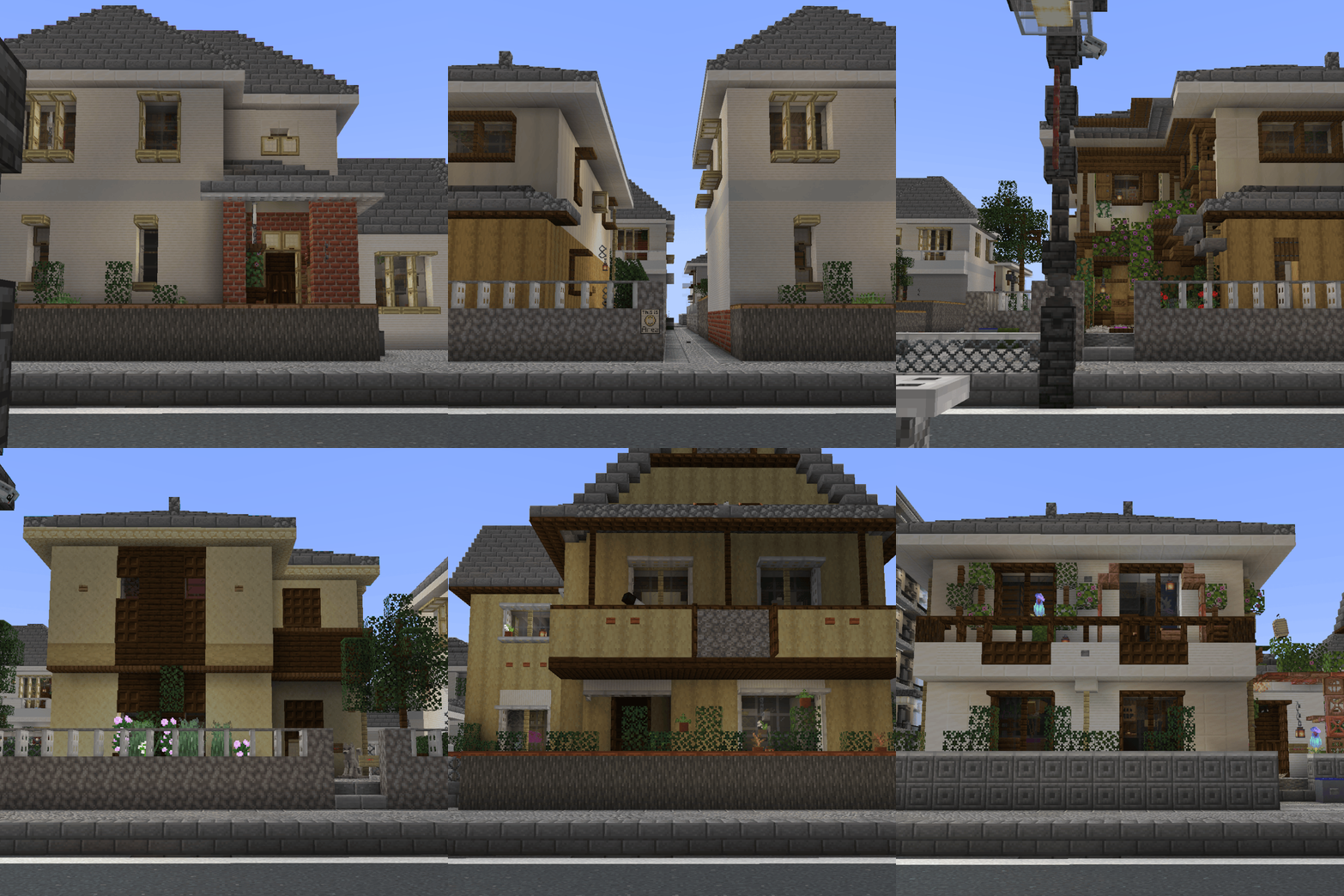
ⓘ Various Houses in Karakura |
| Complex V Other examples include complexes such as Complex V. Complex V is a large complex within the shōtengai housing 43 Penthouse style apartments. Similar to houses this complex also features 100% occupancy, also due to the scarcity factor. Caused once again by factors increasing the perceived value of the property. In this case, those being the physical size of the apartments as well as the location. Right next to the Shopping district and on top of one of the town's four subway stations. As well, compared to other complexes the exterior, interior, and general surrounding area are much cleaner and appealing compared to other complexes. Even sporting its very own fully functioning elevator. | 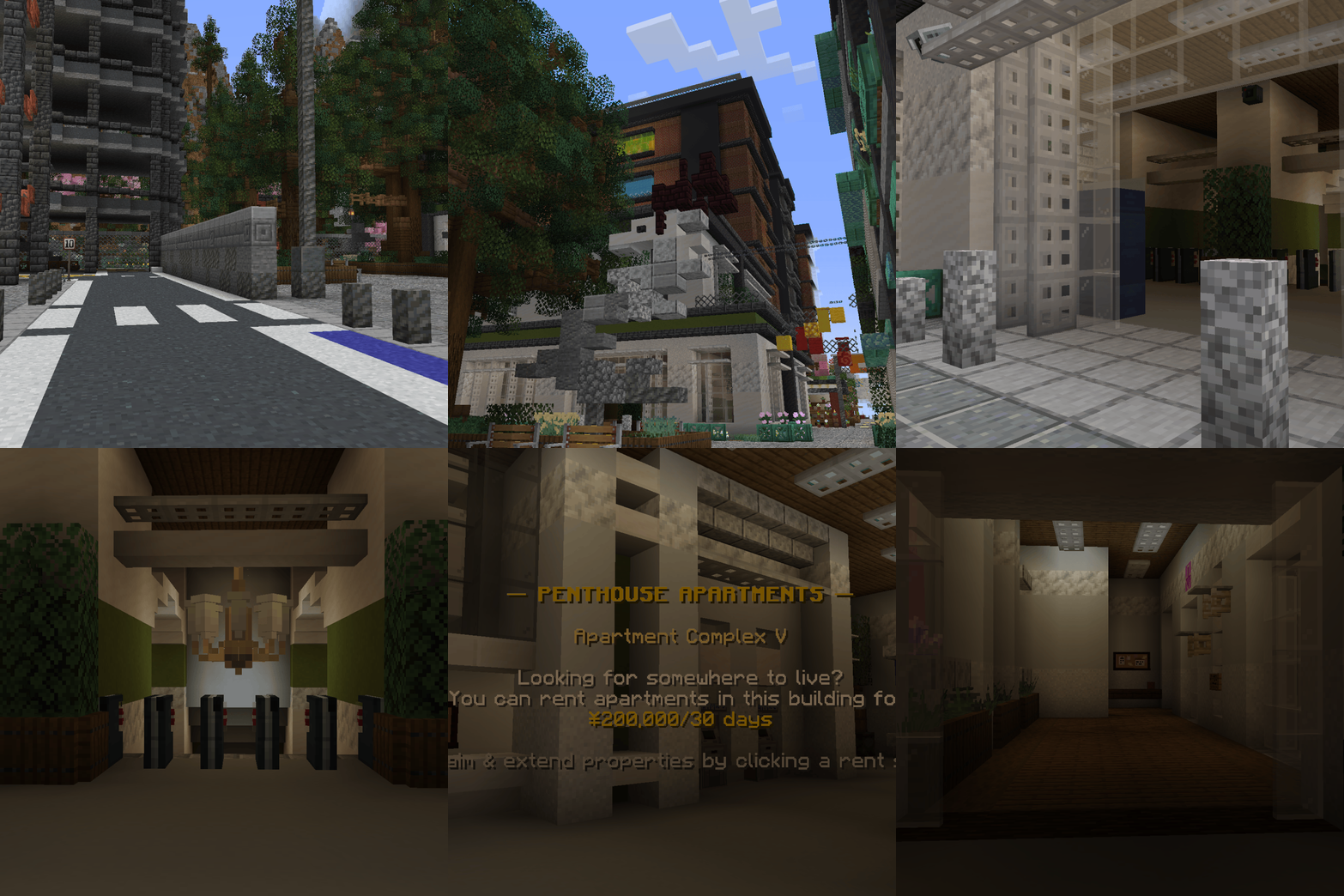
ⓘ Complex V |
The following Complexes or properties, for the record, have 100% occupancy rates:
- Houses
- Complex A
- Complex B1
- Complex B2
- Complex C
- Complex S
- Complex Q
- Complex N
- Complex V
- Complex D
- Complex E*
- Property F*
- Complex U
*Complexes that had near 100% occupancy, but fell short due to 1-2 apartments either being recently enlisted(E) or under repairs(F).
Low Occupancy Properties
On the other side of the spectrum are properties with low occupancy rates due to low perceived value whether again due to the factors mentioned or any other ones attached to the properties, such as unclean exterior or interiors. However, this isn’t always the case. The value of a property can still be of moderate value while having low occupancy rates, this often being due to specific factors about the building which we will get into during our exploration of these properties| Complex O One such example is Complex O which has a surprising Occupancy of 0.00%, at least when checked during this investigation. Meaning, out of the vast population of the city not a single soul wished to rent out a property at this Complex, and it's fairly obvious why. The Complex when you first enter greets you with overflowing trashbins and trashbags across the ground. With many apartments being empty or abandoned lowering the overall shimmer of the complex. This is the only single complex with zero occupants and is likely to subject to change as eventually someone will be daring enough the rent out a property | 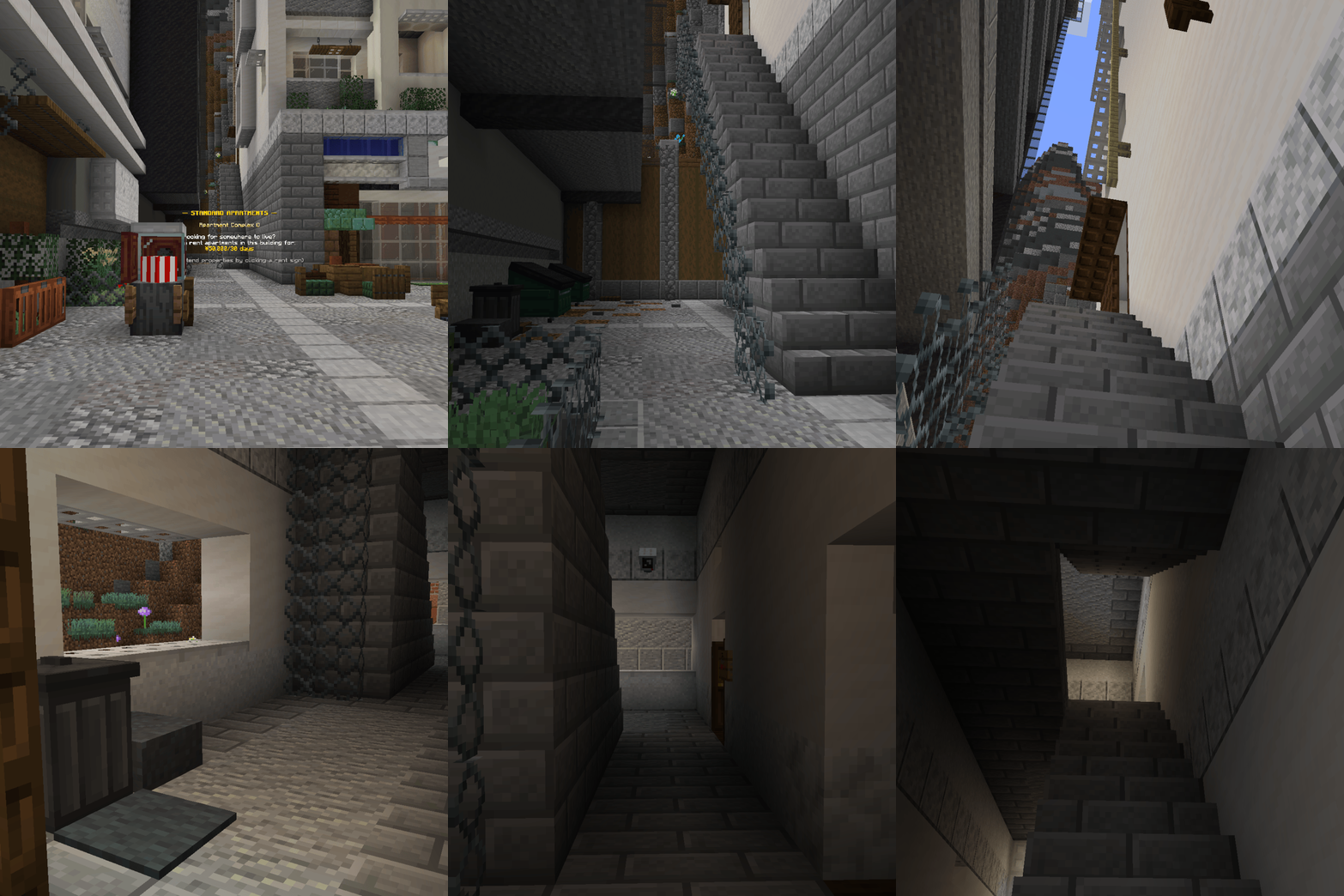
ⓘ Complex O |
| Another example is Complex L, which is one of the aforementioned complexes that while not inherently low in value, such as Complex O, does still sport a low occupancy rate. So why is this? This is when we bounce back to the supply aspect of supply and demand. Complex L is the biggest complex in regard to available units. With over 106 units to be rented by citizens and a 44.34% occupancy rate the complex simply does not have high enough value to fill all of those units. This is at no fault to the complex or the management of it, simply during the construction period the builders assumed a larger amount of value would be expected leading to many vacant units, and given its position it's not exactly possible to increase value of the property. It is clean, has plenty of CCTV, is also next to a subway stop and has a fully functioning elevator on top of stairway access. But the property is simply too far away from many of the key points of interest, such as the Plaza, the shōtengai, the business park and the pier. Simply put, it's in an awkward position in relevance to everything else in the city. One such avenue the complex could take is in price. By dropping the price slightly it may be expected to see increased occupancy, without a drop in revenue while filling the 59 unoccupied units. | 
ⓘ Complex L |
Last edited: