

[OOC] The content from here on may be taken ICly.
You'd check in with the latest news surrounding your local magazine on their website, ending with a ".eu"
You notice they have published their second issue.
Overwhelmed by a sense of curiosity, you open the .pdf start reading.
You'd check in with the latest news surrounding your local magazine on their website, ending with a ".eu"
You notice they have published their second issue.
Overwhelmed by a sense of curiosity, you open the .pdf start reading.

Anonymous: (On the ‘human rights’ spoken of in Article 1 of the Constitution of Karakura) “..So would you confidently say that all rights stated in the 30 articles of the UDHR (are) recognized and respected by the Constitution of Karakura?”
Attorney General Romulus Giordano: “The UDHR are recognised here in Karakura and yes respected as far as I’m aware.”
. . .

Universal Declaration of Human Rights, 10 December 1948
Universal Declaration of Human Rights, 10 December 1948
Article 9: No one shall be subjected to arbitrary arrest, detention or exile.
Article 18: Everyone has the right to freedom of thought, conscience and religion; this right includes freedom to change his religion or belief, and freedom, either alone or in community with others and in public or private, to manifest his religion or belief in teaching, practice, worship and observance.
Article 19: Everyone has the right to freedom of opinion and expression; this right includes freedom to hold opinions without interference and to seek, receive and impart information and ideas through any media and regardless of frontiers.
Article 20.1: Everyone has the right to freedom of peaceful assembly and association.
Article 21.1: Everyone has the right to take part in the government of his country, directly or through freely chosen representatives.
Article 21.3: The will of the people shall be the basis of the authority of government; this will be expressed in periodic and genuine elections which shall be by universal and equal suffrage and shall be held by secret vote or by equivalent free voting procedures.
Article 27.2: Everyone has the right to the protection of the moral and material interests resulting from any scientific, literary or artistic production of which he is the author.
Article 28: Everyone is entitled to a social and international order in which the rights and freedoms set forth in this Declaration can be fully realized.
SOCIAL CONTRACT THEORY AND THE VIOLATED KARAKURAN
by "Mgr. Nebî"
A social contract is a written or unwritten set of ideas, theories, and conduct that produces what we define as the basis of the legitimacy of a state or government in its rule over the individual. It is one of the core concepts of constitutionalism as we know it today. Though it may stay unwritten, it’s usually found in constitutions. Almost all constitutions have ideals that she expresses in her preamble and in her first articles, with the constitutional tradition of the following ones expanding on them.
A social contract is a two-sided agreement between the state and the nation, meaning the people over whom she has jurisdiction. It is written by the populace through a process of discussion and surrender. The people consent to giving some of their rights away for the security of other ones under the state. The people retain the right to revise their contract without obstruction from the state. The state is merely a tool formed by the people; thus, it may never conflict with the people. In conclusion, this agreement may be comparable to the terms & conditions of a company. It may only be changed by one side, the people in our case, and if the other side, the state, is willing to continue utilizing the service, they must accept the terms in their entirety.
In the case of a violation of the social contract by the populace or some individuals, the state retains the right to enforce the social contract through actions against the perpetrators through the principle of individual criminal responsibility and avoiding collective punishment. One example could be deploying rubber bullets or other devices that produce unnecessary harm with the aim of incapacitation against the entirety of a group exercising their right to protest solely because a small minority of them decided to riot. Likewise, the people retain the right to disband the state or reorganize it in the case of the state violating the contract, as the will of the people justifies the existence of a state or government. If the state no longer keeps its promises or goes against the will of the people, it has no legitimacy justifying its existence.
Now that we have defined what a social contract is, we can start an evaluation of the Karakuran social contract, the constitution; what rights it gives to the populace and what rights it takes in return.
In Article 1, the state promises not to violate the human rights of individuals in any way, shape, or form, per the use of the word never. You may ask, what are human rights, as it may sound ambiguous. As admitted by the Attorney General, Romulus Giordano, it entails the rights given in the Universal Declaration of Human Rights. The UDHR gives the individual inalienable rights in its preamble and 30 articles. You may access the full document online; however, we will take an interesting excerpt from it that we have not mentioned before.
· “...Whereas it is essential, if man is not to be compelled to have recourse, as a last resort, to rebellion against tyranny and oppression, that human rights should be protected by the rule of law...” If we simplify, we are left with this sentence: Upholding the rule of law is essential; people should not have to resort to rebellion against tyranny to protect their rights. This sentence in the preamble inexplicitly gives people the right to rebellion if they are faced with oppression to protect their rights.
In Article 2 of our Constitution, it is stated that the rights and freedoms given have been decided by the Government of Karakura. This article is in direct violation of the idea of a constitution; as we have mentioned before, the people decide the terms of their social contract. This article turns the tables, with the State defining the terms of the social contract and the people being forced to accept its terms. This eradicates what little legitimacy the Government of Karakura has.
In Article 5, it states that the freedom of thought, religion, conscience & speech shall not be violated unless found in violation of Karakura’s laws. Though it may seem innocent and good intentioned, when examined, we find that it makes oppression much easier. In other states, the cases in which limitations to such rights can be made are explicitly laid out in the article that provides such rights or in other articles. What’s the difference, one unfamiliar with law may ask?
The answer is that constitutions are much harder to alter than laws. In a place such as Karakura, where new laws can be legislated without democratic processes, those rights can be limited easily by legislators. However, as the constitution and laws are a social contract, the consent of the people is a requirement for change. If altered without such consent, the people shall use their right to dismantle the state by any means.
In Article 10, the right to petition for change of all kinds involving the State is given. However, no guarantee of change is given either. This article serves no purpose other than its subsections.
We have completed our evaluation, we can list out the rights relevant to our conversation the Karakuran has, according to the Constitution:
· Right to rebellion (UDHR Preamble)
· Right to life, liberty, security, happiness (UDHR art. 3, Const. art. 3, 9)
· Right to protection from arbitrary arrest, detention, exile (UDHR art. 9, Const. art. 9)
· Right to assumption of innocence in court (UDHR art. 11, in conflict with Const. art. 17. Const. states the individual is to plead their innocence, rather than the prosecution being responsible for proving guilt)
· Protection from interference with their privacy, family, home, from attacks upon their honor and reputation (UDHR art. 12)
· Right to freedom of thought, conscience and religion either alone or in community with others and in public or private; in teaching, practice, worship and observance (UDHR art. 18, Const. art. 5)
· Right to freedom of opinion and expression, to hold them without interference, the right to receive and share them through media (UDHR art. 19, Const. art. 5)
· Right to peaceful assembly (protest) and association (coming together to form unions, clubs, political groups) (UDHR art. 19)
· Right to take part in government directly or through freely chosen representatives (TLDR; democracy) (UDHR art. 21)
· Right to periodic and genuine elections (UDHR art. 21)
· Right to social security and an adequate standard of living (UDHR art. 22, 25)
· Right to employment and protection from unemployment (UDHR art. 23)
· Right to protection of material resulting from any scientific, literary or artistic production (UDHR art. 27)
· Right to a state that respects all rights above (UDHR art. 28)
We today have learned about the social contract, learned about Karakura’s social contract, and we ultimately have been left with the conclusion that the Government of Karakura has failed to uphold its Constitution and values. She has strayed from her mission. If violations continue, she may very well be disbanded.

Primer on the Vajra and Vajra Bell, Chapters I-IV.
By "Lopön Methawi Yeshe"
By "Lopön Methawi Yeshe"

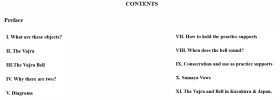
PREFACE
This text is being created for the benefit of the Karakuran Saṅgha that is slowly but surely seeing Buddhist Practice revived in our humble prefecture. It is not intended to be comprehensive. I have gone ahead and created this primer for those practitioners who have encountered the vajra and vajra bell but have yet to understand their purpose, some of their symbolism, and the care with which they ought to be approached. Karakura is a place in which many traditions have met, mingled, and sometimes been forgotten. As Buddhist practice finds new life here, it is important that its practitioners do not inherit its forms without also inheriting the understanding that gives those forms meaning May this small work serve not merely to explain two ritual implements, but to encourage the careful study, sincere practice, and compassionate conduct upon which the Dharma depends.
~Lopön M. Yeshe
I. What are these objects?
Before even examining each of the objects individually, let's just discuss what they actually ARE and what they ARE NOT. They are not instruments, but 'practice supports'. What 'practice' do they support? Spiritual practice. Buddhism.
You may have seen its likeness before. In Japan, the vajra is not an alien symbol. You may know it as the kongō, or have seen it upon the altar of a mikkyō temple. But recognition is not understanding.
The pair are used together during prayers, chanting, and meditation. They're also extremely symbolic items in addition to serving these practical purposes. This text will consider them individually, then 'together'.
It is worth, however, before proceeding, learning about the specific 'branch' of Buddhism these implements actually find themselves being used. That being: Vajrayāna Buddhism also known as Tantric or Esoteric Buddhism.
This text simply DOES NOT HAVE THE TIME or pages necessary to cover the three 'branches', but it is sufficient to say Vajrayāna Buddhism, seen as a specialized branch or fast-track extension of Mahayana, sees heavy use of esoteric and tantric techniques, mantras, ritual, etc.
Part of such visualizations, and ritual practices often involves the use of ritual tools or implements. Practice supports. The Vajra and Vajra Bell are, together, an example of this. They see heavy use for these purposes. Though usually used together, there are some contexts in which the bell or vajra alone is used in conjunction with other implements (e.g. a Damaru drum). However, they're most often utilized and thought about together.
II. The Vajra 'What it is'
The Sanskrit word vajra translates to "thunderbolt" and "diamond". The word is trying to convey 'indestructability in this way. The thunderbolt symbolism comes from Indra, the Vedic god of weather associated with the Vajra.
In the Buddhist context though, it's divorced from this association with Indra, and symbolizes an unshakeable mind, spiritual power, & the clear wisdom that cuts through all illusions. It is, however, often said to represent masculine energy, skillful method, and compassion.
It is not simply an object whose historical symbolism is interesting. It is a practice support: an implement deliberately incorporated into tantric ritual, meditation, visualization, mantra, mudrā, offerings, consecrations, blessings, and other practices.
A vajra ordinarily consists of a central grip from which prongs extend toward one or both ends. The precise construction varies considerably. Vajras in Karakura tend to have 'five prongs' on each side (5-pronged Vajras). Indeed, this familiar five-pronged vajra is particularly common. Its two ends mirror one another, with the prongs curving inward toward the central point. The central body commonly incorporates lotus imagery and other decorative features.
The entire length of this book, quite frankly, could just unpack the symbolism that is seeped into this object, but that is beyond the scope of this text. For a beginning practitioner, the important thing is not to memorize what every individual feature represents. Rather... one should first learn to recognize the implement as a vajra, learn how it is properly handled, and learn the practice in which your teacher has instructed you to use it. Its more elaborate symbolism can be studied as your practice develops.
What makes it a ritual implement? NOT possession. Its significance comes from its place within the Buddhist practice for which it has been adopted, the instructions received from one's teacher, and the commitments associated with that practice. Its presence in your possession does not, by itself, confer empowerment, realization, or authority to perform tantric practices...
See chapters:
IX. Consecration and use as practice supports
X. Samaya Vows
What does the vajra represent? Though this text, again, won't cover 'all the symbolism' baked into the design, it is well worth observing what the Vajra more broadly is understood to represent. The most important correspondence for the beginner is that the Vajra is symbolic of: Method and "skillful means" ('upaya')\; "practical action and compassionate activity. Basically, the action-oriented half of the spiritual path.
5 of the 6 Perfections ('pāramitās'), when linked to the path of the bodhisattva, see symbolic representation:
1. Generosity (dana)
2. Morality/ethics (sila)
3. Patience (kshanti)
4. Perseverance (viriya)
5. Concentration (dhyana)
So the VAJRA represents those five, the paired VAJRA bell represents the last perfection:
6. Wisdom ('Prajna)
The pāramitās are the core 'method' (practice) guiding Bodhisattvas to the enlightenment. Without the method, wisdom remains abstract and passive. Without wisdom, the method can become misguided or self-serving. Together, they form the complete path of the bodhisattva. For this reason, the Vajra and Vajra Bell are 'paired'.
III. The Vajra Bell
The Vajra Bell ('Ghanta') ('drilbu'), complementary to the Vajra (Dorje) is understood to represent feminine energy, wisdom (prajna), and emptiness (śūnyatā), held in the left hand.
What is 'emptiness'? Emptiness or 'śūnyatā' can often seem rather abstract or ominous to those without the context. The simplest explanation this book could offer is that it carries a really DENSE philosophical meaning that frankly could warrant its own book or volume. But, for the sake of brevity, we can say śūnyatā is a description or philosophical view of reality that maintains a few key things.
1. No 'inherent' self; nothing exists totally by itself, nor possesses permanent, independent core or essence (e.g. 'soul').
2. You are, BY CONTRAST, a constantly changing mix of physical and mental parts (the five aggregates): body, feelings, perceptions, mental habits, and consciousness. All things arise and change based on causes, conditions, and relationships with other things.
Many misunderstand śūnyatā as a negative or nihilistic view that life lacks meaning. This is incorrect: it merely describes reality, and, from the Buddhist view, that reality is, far from being 'without meaning', is dynamic, fluid and full of potential. But let us not get off-topic. We are here SIMPLY to observe in this chapter that the bell represents precise that: śūnyatā.
Contemplating śūnyatā is rather fundamental to Mahayana and Vajrayana Buddhist practice: but that will not be covered by this text. The bell is our focus in this chapter. It is not simply a musical instrument. Within tantric practice it is a ritual implement: an object used in particular practices to accompany mantra, mudrā, visualization, offerings, and other prescribed actions.
IV. Why there are two? (i.e. why are the objects 'paired')?
The Vajra, represents 'method' and the Bell representing 'wisdom' are paired because both wisdom and method are needed to reach enlightenment. One without the other is seen as 'lacking'. Compassion without wisdom is just blind emotion, and wisdom without compassion lacks active benefit for others. Merging the two hands in ritual mimics their non-dualistic union.
SO;
Bell + Vajra = union of Compassion/Method + Wisdom.
Non est ad astra mollis e terris via, per aspera ad astra! Valete, lectores.

